
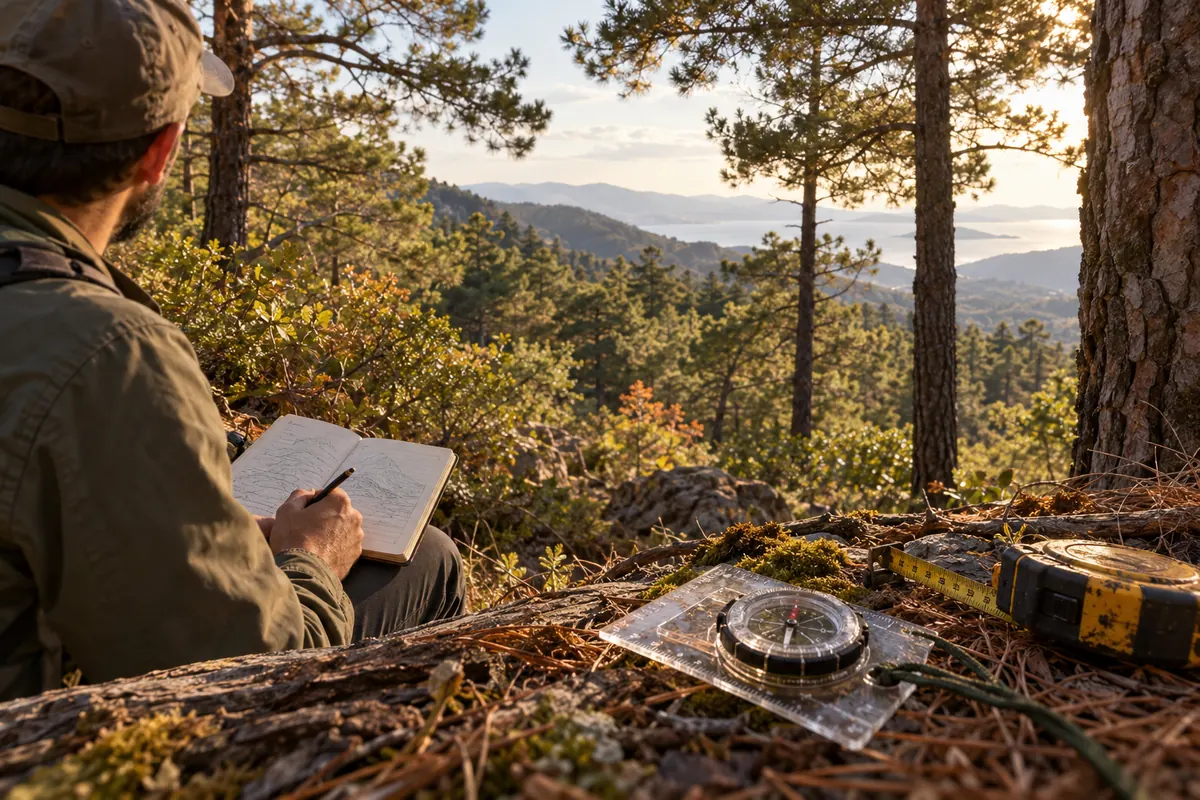
Guided by your site.
Forest management, tending and sustainable use require planned technical work. Site conditions and project needs guide management and silvicultural plans, tending and regeneration projects, inventories and feasibility studies.
Who is it for?
Private forest owners, forest operators, project teams and forest product investors.
Services in this area
Select a service to read its description.
Young forest stand tending project
The species composition, distribution and development of young forest regeneration, along with surrounding competition, are assessed in the field. Intervention needs are identified for those seeking to support young tree growth and plan tending work in the appropriate areas. The project sets out the sections to be treated, the operations to be undertaken and the development indicators to be monitored afterwards.
Discuss this service →Forest soil surveys, analysis, improvement and site quality assessment
Forest soil structure, depth, water retention and conditions affecting plant growth are evaluated through field surveys and appropriate analyses. Site quality, reflecting the productive capacity of the growing environment, is assessed alongside relevant field and stand data, while soil problems and improvement needs are identified. The results are presented as technical assessments and improvement recommendations to support species selection and tending decisions.
Discuss this service →Planning forest fire access roads and firebreaks
The forest area's topography, vegetation, existing access network and fire response needs are assessed together. The locations of fire access roads and firebreaks are planned with regard to site characteristics and access and maintenance requirements. The plan shows proposed routes, firebreak arrangements and implementation details, providing a basis for fire prevention and response preparation.
Discuss this service →Forest site analysis, inventory and mapping
The growing conditions that influence forest development, including climate, topography, soil and vegetation, are examined together. Areas with similar conditions are identified through inventory work and mapped spatially. The resulting analysis, inventory and maps describe the site's different sections, ecological features and growing conditions for use in afforestation, tending or forest management decisions.
Discuss this service →Non-wood plant product inventories
The species, distribution, available quantities and key use-related characteristics of non-wood plant products on the site are identified. The inventory shows which products occur where and how the site's potential is distributed, supporting planning needs. The data are compiled into an inventory comprising product and site records, tables and maps where needed.
Discuss this service →Implementation projects for non-wood plant products
The intended use of non-wood plant products is assessed in relation to product characteristics and the site's existing potential. The locations, methods and sequence of collection, production or tending work are planned with resource continuity in mind. The implementation project explains the scope and technical approach of on-site work, helping turn inventory information into a practical work programme.
Discuss this service →Feasibility reports for non-wood product processing facilities
Raw material supply, production approach, capacity needs and key investment elements of a non-wood product processing facility are assessed together. Technical and economic feasibility is examined using available data and clearly stated assumptions. The feasibility report identifies alternatives and resource requirements, helping explain the project's strengths and uncertainties before an investment decision is made.
Discuss this service →Technical reports for non-wood product processing facilities
The production method, capacity, layout and raw material requirements of a non-wood product processing facility are examined technically. The assessment clarifies how the facility is intended to operate and identifies the project's main technical needs. The report clearly presents the process, land use and facility characteristics, providing a facility-specific engineering assessment for planning or documentation work.
Discuss this service →Digitisation of forest management plans
Maps, tables and other data from existing forest management plans are converted into a structure suitable for digital use. Data consistency is checked while preserving the relationships between spatial information and associated records. The digitised output provides an organised planning dataset that makes it easier to query areas, update data and use plan information in mapping or management work.
Discuss this service →Restoration projects for detailed tree care in forest vegetation
Forest trees and other relevant plants requiring care are assessed in detail for their current condition and development problems. A care and improvement approach suited to each plant is established, with the scope and sequence of interventions explained. The restoration project turns work to conserve and improve the vegetation into a technical programme that can be followed on site.
Discuss this service →Surveys, plans and projects for establishing forest genetic conservation areas
Species, tree populations, growing conditions and conservation needs are assessed on the proposed forest genetic conservation site. Site selection and the management approach for conserving genetic resources are linked to survey findings. The plan and project explain the selected area's boundaries, vegetation to be protected and proposed measures, establishing a technical basis for creating the conservation area.
Discuss this service →Rural development planning and implementation projects
Natural resources, existing production opportunities and local needs in a rural area are assessed within the intended development initiative. A practical approach is developed by coordinating the proposed activities' land use, technical requirements and implementation sequence. The plan and implementation project provide a concrete roadmap explaining how resources are to be used and how the work is proposed to proceed.
Discuss this service →Young plantation tending projects
The development of a newly established forest plantation or afforestation site, the condition of seedlings and tending needs are assessed. The scope and sequence of weeding, soil cultivation or similar tending operations are determined according to site conditions. The project explains area-specific interventions to support young plant growth, creating a technical work programme that tending teams can follow.
Discuss this service →Grazing Plans for Forests, Pastures, Summer Pastures and Winter Grazing Areas
Vegetation, forage resources, terrain and grazing pressure are examined together. Grazing zones, periods and resting arrangements are planned with consideration for how livestock use the area and the need to protect its vegetation. The resulting plan sets out a land-use arrangement and technical principles suited to the characteristics of the forest, pasture, summer pasture or winter grazing area.
Discuss this service →Forest Management Plans for Private Afforestation and Restoration Areas
The existing structure and development of tree cover, together with management objectives, are assessed in private afforestation and forest restoration areas. Tending, cultivation and resource-use decisions are organised for each part of the site with regard to its development over time. The forest management plan addresses management needs after initial establishment and sets out the purposes and technical principles governing the area.
Discuss this service →Road Network Plans for Private Forests
The private forest's terrain, existing roads and access points needed for tending, production or protection work are assessed. Road routes are planned as an interconnected access network, taking slope and the integrity of the site into account. The road network plan maps existing and proposed connections, providing a technical framework for access to work areas within the forest.
Discuss this service →Forest Management Plans for Private Forests
Tree species, stand structure, development and land-use objectives in the private forest are examined using field data. Tending, regeneration, protection and resource-use decisions for different parts of the forest are considered within a long-term management framework. The forest management plan sets out the current condition of resources and proposed interventions, helping the owner organise management work into a technical programme.
Discuss this service →Young Stand Tending Projects
Tree distribution, competition and development in young forest areas are examined to identify tending needs. Intervention areas and a tending approach that supports future stand structure are planned according to site characteristics. The young stand tending project provides a practical framework for this work by setting out the development pattern to be maintained and the technical principles to be applied.
Discuss this service →Silvicultural Plans
The forest's species composition, age and development structure, growing conditions and management objectives are assessed together. Interventions for stand cultivation, tending and renewal are organised in a technical sequence according to the needs of each section. The silvicultural plan covers more than a single tending operation, setting out the practices that will guide forest development and their distribution across the site.
Discuss this service →Artificial Forest Regeneration Projects
The existing stand, soil and growing conditions are assessed where a new forest generation is to be established through planting or sowing. Species selection, site preparation, establishment methods and initial tending needs are determined alongside the regeneration objective. The project identifies implementation areas and technical working arrangements for establishing new tree stands by artificial means in place of, or in support of, natural regeneration.
Discuss this service →For our initial discussion
- Forest or project area location and boundaries
- Existing plans, inventories and mapping data
- Purpose of the proposed planning or implementation
- Technical requirements and previous studies, where available
The final scope and document requirements are defined alongside site conditions and current authority requirements.